Nigeria’s Broadband Crisis is governance, not bandwidth, Industry Leaders Warn at National Connectivity Workshop.
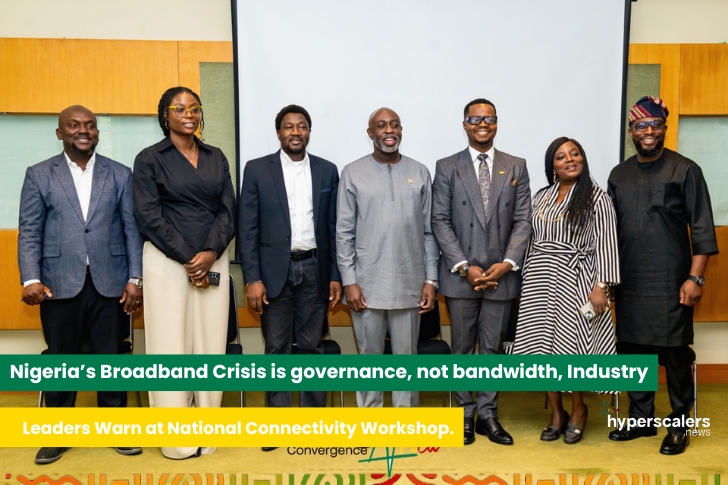
Nigeria may have more subsea capacity than almost any African nation, but its digital progress is being slowed not by bandwidth shortages but by fragmentation, duplication, and the absence of a coordinated national framework. This was the central message at the Africa Hyperscalers Connectivity Strategy Workshop in Lagos, where senior officials, network operators, tower companies, ISPs, data center leaders, and regulators convened to chart a unified path for Nigeria’s broadband future.
Despite eight subsea systems delivering more than 360 terabits per second to Nigeria’s shores, fixed broadband penetration remains stuck below 6 percent. Participants pointed to the same underlying cause: the country lacks a coordinated plan spanning the subsea, middle-mile, metro, and last-mile layers of its connectivity ecosystem.
“The infrastructure is coming into the country,” one participant noted, “but it is not moving through the country.”
Throughout the workshop, operators emphasized that Nigeria must shift decisively away from isolated, operator-by-operator deployments and toward coordinated middle-mile and metro integration. Stakeholders urged the Federal Government to accelerate Project Bridge, the proposed 90,000-kilometer national fiber program, and embed open-access principles from inception. Operators committed to adopting subsea-style consortium models for inland builds and to sharing route plans to eliminate the costly duplication that has defined the market for years.
A single 96-core fiber run along Lagos’s Third Mainland Bridge costs approximately N248 million ($171,000). In many cases, more than a dozen such runs exist on the same corridor -capital that could have been deployed into underserved states. Participants agreed that this inefficiency has become a national competitiveness issue, putting Nigeria at risk of falling significantly behind Kenya, South Africa, and smaller markets that have already adopted open-access and co-build frameworks to accelerate national coverage.
To reverse this trend, attendees called for the creation of a National Co-Build Consortium, modeled after the multi-operator partnerships that have successfully delivered Africa’s biggest subsea systems, including 2Africa and Equiano. Industry leaders argued that the same collaborative approach that transformed Africa’s subsea landscape must now be applied inland.
Another cornerstone of the discussion was Nigeria’s state-level fragmentation. Instead of pursuing a single harmonized national rulebook, participants recommended a 36-state connectivity pact built on memoranda of understanding, permitting reforms, and reciprocal commitments. The proposed model includes a unified rights-of-way portal, predictable approval timelines, and performance-based incentives for broadband expansion.
Participants highlighted the difficulty of financial institutions in funding ISP-led projects due to governance gaps, weak audits, and limited long-term revenue visibility. They argued that open-access wholesale infrastructure, availability guarantees, and consortium-led builds would meaningfully improve bankability and unlock investment from DFIs, pension funds, and private credit providers.
The workshop also addressed a growing concern: domestic traffic continues to leave the country unnecessarily. Banks, oil and gas companies, and major enterprises frequently route local traffic through Europe, increasing costs, reducing efficiency, and weakening Nigeria’s data protection efforts. Participants highlighted the need to expand Internet Exchange Points (IXPs) beyond Lagos, Abuja, Kano, and Enugu, and to incentivize CDN and edge deployments across more cities.
By the close of the session, industry leaders endorsed the establishment of a Connectivity Working Group, a coordination body constituting regulators, operators, and other stakeholders that is responsible for maintaining a national infrastructure map, aligning operator commitments, supporting state-level negotiations, and publicly tracking Nigeria’s progress toward 70 percent broadband coverage.
“Without collaboration on infrastructure investments, the industry will continue to suffer operational inefficiencies, gross margin erosion, and poor ROI. The resultant impact is stifled funding for the industry and failed broadband penetration objective,” said Olugbenga Olabiyi, Managing Director, Dimension Data Nigeria.
With Nigeria’s digital economy projected to be one of the country’s fastest-growing sectors, decisions in the coming months on collaboration, policy alignment, financing, and shared infrastructure will determine whether the nation can convert its abundant landing-station capacity into meaningful national access.
“The Connectivity Workshop demonstrated that operators are ready to collaborate in tackling challenges long thought to be intractable. It is this shared optimism—and willingness to work together – that will power Nigeria’s next phase of digital infrastructure growth,” said Temitope Osunrinde, Director, Africa Hyperscalers
The session brought together senior representatives from the Lagos State Government, Airtel, Bayobab/MTN, NATCOM/ntel, IHS Towers/GICL, Fiber One Broadband, Tizeti, Open Access Data Centres, MainOne/Equinix, Cedarview, Infratel, Dimension Data, Avanti, TelCables, WTES, Broadbased Communications, and others. The discussions yielded a shared understanding of the structural barriers hindering broadband growth and a clear mandate for government, operators, and regulators to take action.
Ready to dive deeper into the hyperscale revolution impacting Africa?
READ MORE HERE: www.africa.hyperscalers.news
Contact Us:
Email: projects@hyperscalers.news
Phone: +2348109003350
Follow us on Social Media: Instagram, Facebook, LinkedIn, x