Africa’s hidden internet problem
Africa’s digital economy is growing fast. Bandwidth is expanding, data centers are being commissioned, cloud platforms are multiplying, and digital payments now move trillions of dollars across the continent each year. From the outside, the trajectory looks unmistakably positive.
Look closer at how Africa’s internet actually works, however, and a more uncomfortable reality emerges. Much of the continent still does not control how its traffic is routed, prioritised, or protected. Decisions about where African data travels – and on what terms – are often made elsewhere.
At the heart of this imbalance is a consequential gap: Africa’s low adoption of Autonomous System Numbers, or ASNs. These identifiers allow networks to operate independently on the global internet, choose their routing paths, peer directly with others, and exercise a degree of technical sovereignty.
ASNs rarely feature in public debates about connectivity. To many critics, they sound like an overhyped abstraction – irrelevant to users who care about affordability, coverage, power supply, or cybercrime. Some policymakers view them as mysterious, far removed from the visible work of broadband rollout or digital inclusion programmes. Even within the industry, ASN adoption is sometimes dismissed as unnecessary in markets dominated by a few large mobile networks.
That scepticism is understandable. It is also increasingly wrong.
ASNs are not a technical indulgence. They are the basic instruments through which competition, resilience, and control are exercised on the modern internet. Africa’s underinvestment in them is no longer neutral; it is starting to carry real economic and strategic costs.
A structural gap
The relationship between ASNs and competition is well established. As research presented by Muhammed Rudman, Chief Executive Officer of Nigeria’s Internet Exchange, IXPN shows, markets with higher ASN density tend to have more competitive, resilient internet ecosystems.
The United States has roughly 90 ASNs per million people. Brazil has more than 40. South Africa has over 13. Nigeria – Africa’s largest internet market by users – has about one.
The consequences are predictable. Where ASNs are scarce, routing decisions are concentrated among a small number of upstream providers. Smaller networks struggle to peer directly. Traffic takes inefficient paths. Transit costs remain high. Outages spread further and last longer.
At the continental level, the imbalance is stark. AFRINIC, Africa’s regional internet registry, manages fewer than 3,000 ASNs in total. In Asia-Pacific, APNIC registers more ASNs in a single year than AFRINIC holds altogether.
The result is an internet where African traffic routinely leaves the continent to reach users in neighbouring countries – and where enterprises pay international prices for what should be domestic connectivity.
The objections – and why they fall short
Critics of ASN evangelism raise legitimate points.
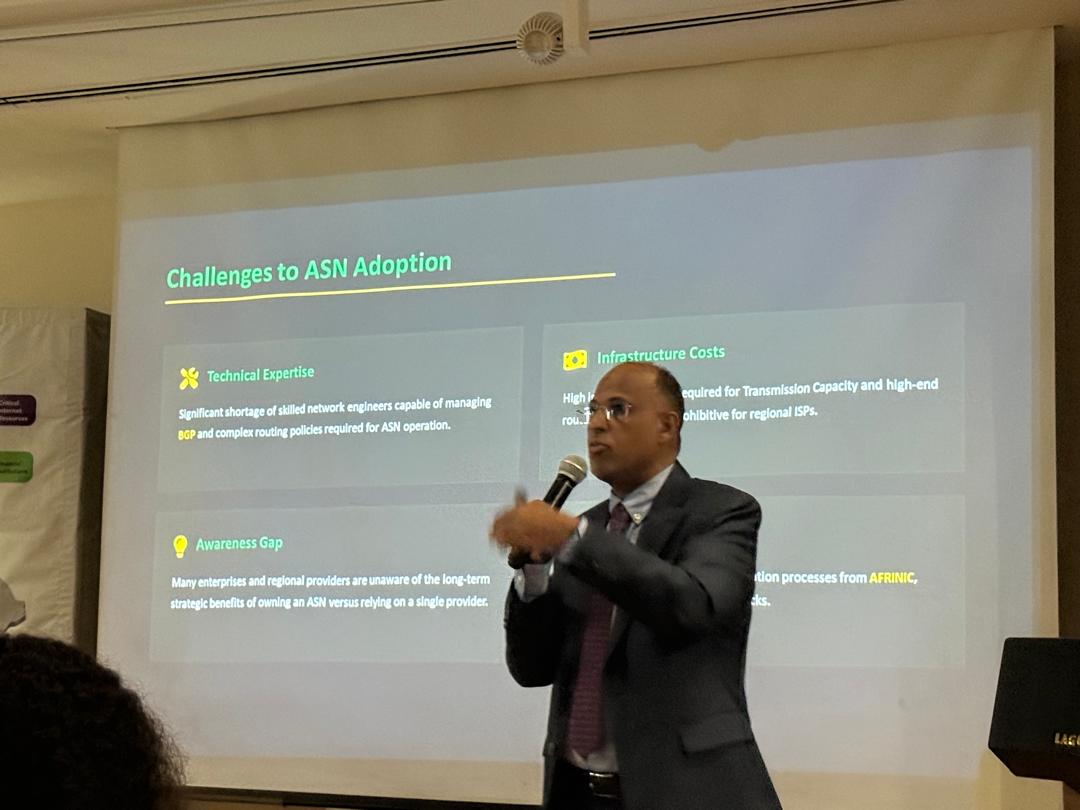
ASNs do not fix last-mile access. A rural community without fibre, towers, or power does not become connected by acquiring a routing identifier. Skills gaps are real: operating an autonomous network requires routing expertise and operational discipline that many smaller providers lack. Poorly configured networks can create instability rather than resilience. And none of this overrides the brutal economics of transmission in markets where long-haul capacity is expensive and margins are thin.
All of that is true.
What it misses is the role ASNs actually play.
ASNs are not substitutes for infrastructure investment; they are multipliers of it. Where capacity exists, ASNs determine whether that capacity is used efficiently or wastefully. Where skills are lacking, ASNs expose the training deficit rather than masking it. Where markets are concentrated, ASNs are often the only mechanism through which new entrants can exist at all.
Ignoring them does not simplify the system. It entrenches dependence.
Why ASN adoption is no longer optional
Three shifts have made ASN adoption unavoidable for Africa.
First, traffic has changed. The internet is no longer dominated by browsing and social media. Payment systems, government platforms, health records, enterprise applications, and emerging AI workloads depend on predictable, low-latency routing. National payment stacks and data-sovereignty frameworks cannot function reliably on networks that remain permanently dependent on upstream transit.
Second, IPv4 scarcity has become an economic fault line. IPv4 addresses now trade globally for up to $50 per IP. Historical allocation patterns mean entities outside Africa still hold more address space than entire African countries, simply because Africans applied too late. Without ASNs, African networks cannot participate rationally in address markets or manage an orderly transition to IPv6.
Third, resilience has become geopolitical. Undersea cable cuts, regional conflicts, and hyperscaler concentration have turned traffic localisation into a national concern. Without ASNs, countries lack the practical ability to control routing policy, mitigate attacks, or keep critical traffic local – even when data centres and IXPs exist on paper.
What actually changes when ASNs proliferate
Where ASN adoption is deliberate rather than accidental, the effects are tangible.
Transit costs fall as networks peer directly. Content providers have a reason to localise infrastructure. Smaller ISPs become viable beyond capital cities. Outages are isolated more quickly. Regulators gain visibility into network behaviour. Enterprises can multihome instead of accepting single-provider dependency.
These benefits are observable outcomes in markets that treated routing autonomy as policy, not hobbyism.
The real lesson
The lesson is not that everyone must acquire an ASN tomorrow. It is that ASN adoption must be treated as infrastructure policy.
That means structured training in BGP, routing security, and IPv6 – not one-off workshops. It means hybrid ASN models that allow early adopters to build capability without assuming full operational risk on day one. It means incentives for enterprises, universities, and content platforms to deploy ASNs locally, backed by regulatory clarity that encourages autonomy without destabilising networks. And it means transmission pricing reforms so autonomous routing is economically viable, not a penalty.
Above all, it requires a shift in mindset: from viewing the internet as a service Africa consumes, to infrastructure it actively governs.
The cost of delay
Africa does not lack ambition. It lacks leverage.
Without ASNs, African networks remain price takers in a global system they barely influence. With them, the continent gains bargaining power over cost, performance, and policy.
The choice is not between fixing access and fixing routing. It is whether Africa wants an internet that merely arrives – or one it can shape.
Autonomous networks are not a silver bullet. But without them, Africa’s digital future will continue to run on other people’s terms.